

By Yilan Liao, Yan Zhang, Lei He, Jinfeng Wang, Xin Liu, Ningxu Zhang, and Bing Xu
“Background: Neural tube defects (NTDs) are congenital birth defects that occur in the central nervous system, and they have the highest incidence among all birth defects. Shanxi Province in China has the world’s highest rate of NTDs. Since the 1990s, China’s government has worked on many birth defect prevention programs to reduce the occurrence of NTDs, such as pregnancy planning, health education, genetic counseling, antenatal ultrasonography and serological screening. However, the rate of NTDs in Shanxi Province is still higher than the world’s average morbidity rate after intervention. In addition, Shanxi Province has abundant coal reserves, and is the largest coal production province in China. The objectives of this study are to determine the temporal and spatial variation of the NTD rate in rural areas of Shanxi Province, China, and identify geographical environmental factors that were associated with NTDs in the risk area.
“Methods: In this study, Heshun County and Yuanping County in Shanxi Province, which have high incidence of NTDs, were selected as the study areas. Two paired sample T test was used to analyze the changes in the risk of NTDs from the time dimension. Ripley’s k function and spatial filtering were combined with geographic information system (GIS) software to study the changes in the risk of NTDs from the spatial dimension. In addition, geographical detectors were used to identify the risk geographical environmental factors of NTDs in the study areas, especially the areas close to the coal sites and main roads.
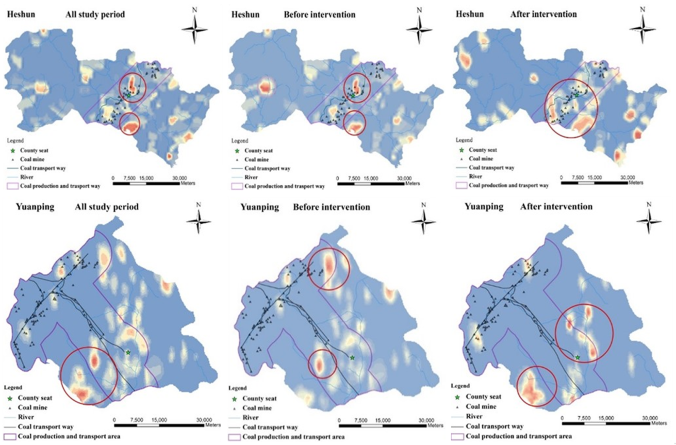
“Results: In both Heshun County and Yuanping County, the incidence of NTDs was significantly (P