
In the 1960's, the Aral Sea was the fourth largest inland body of water in the world with over sixty-five thousand squared kilometers of surface area. The Amu Darya and the Syr Darya are two rivers that flow into the Aral Sea and were heavily used in the sixties due to Soviet Union plans. Consequently to the over usage of the rivers during the sixties, the Aral Sea visibly split into what is now called the "Large Aral Sea" as the southern region and the "Small Aral Sea" as the northern region. Predictions have been made claiming that by the year 2057, the Aral Sea will have completely diminished if surrounding cities continue methods that are currently emptying the sea. The complexity in disappearance of the Aral sea is the fact that as of now it poses as one of the largest irrigation sources for Central Asia. With an outburst in population growth continuing to threaten the existence of life on earth, the question emerges of how to feed such a surplus of people. As for an answer, humans continually rely on new methods of agriculture which is the reason for the Aral Sea shrinking in the first place. The more agriculture, the more water needed; that is kind of a simple concept that creates an issue nearly impossible to solve. In comparison to the size of the sea in the 1960's, the entire sea has shrank in surface area by 79%. However, that statistic is only dating up to 2011. There is no telling of how much water has been used in the past five years from the Aral Sea. These maps will show the outstanding disappearance of the Aral Sea:
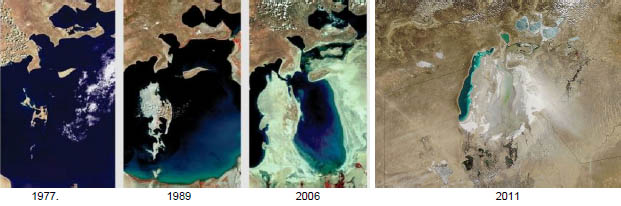

By visibly seeing the shrinkage of the sea, humans naturally will tend to care more about the issue. By analyzing actual maps of the sea and surrounding area maps, someone could come up with other possible water sources to prevent the complete disappearance of sea. The Aral Sea is rather just a smaller mishap that acts as a representation of how humans have impacted this earth.
I have acted with honesty and integrity in producing this work and am unaware of anyone who has not- Austyn Laird
Gaybullaev, B., Chen, S., & Gaybullaev, G. (2014). The large Aral Sea water balance: a future prospective of the large Aral Sea depending on water volume alteration. Carbonates & Evaporites, 29(2), 211-219. doi:10.1007/s13146-013-0174-1
أكثر...
By visibly seeing the shrinkage of the sea, humans naturally will tend to care more about the issue. By analyzing actual maps of the sea and surrounding area maps, someone could come up with other possible water sources to prevent the complete disappearance of sea. The Aral Sea is rather just a smaller mishap that acts as a representation of how humans have impacted this earth.
I have acted with honesty and integrity in producing this work and am unaware of anyone who has not- Austyn Laird
Gaybullaev, B., Chen, S., & Gaybullaev, G. (2014). The large Aral Sea water balance: a future prospective of the large Aral Sea depending on water volume alteration. Carbonates & Evaporites, 29(2), 211-219. doi:10.1007/s13146-013-0174-1
أكثر...