
How to research, collaborate, educate and optimize institutional workflows with the help of mapping technology?

Interdisciplinarity is a common word in the world of contemporary education. At the institutional level, it highlights one of the most important facets of increased flow of information and ideas – collaboration. Literally, interdisciplinarity signifies working between diverse academic disciplines, while the main goal is to combine subjects together in new ways to achieve a specific purpose. That kind of prospect asks for intensification of networking and features collaboration between people with different academic and practical background.
Most of all, a need for an interdisciplinary approach is visibly present in sciences such as geography, definition of which strongly implies the notion of interdisciplinarity. GIS, Geographic Information System merges cartography, statistical analysis, and database technology, with the purpose of storing, analyzing, and displaying geographical information. This data can be used later on for the purposes of projects, decision-making, lectures and for other purposes.
Using GIS software for academic needs magnificently serves the notion of interdisciplinarity in academic terms. The spatial dimension of research is important for disciplines in the range from environmental research, to archaeology or population genetics. All of these fields of study often require a help from mapping technology to display, interpret and analyze the data.
 An example from Patho Map project : Displaying the pathogen map or “PathoMap” of New York City and surrounding areas
So, the first, most obvious use of GIS for academic projects in a wider sense is for the uses of collaboration on various projects between different disciplines.
In a more direct and narrower sense, GIS is widely used in educating the generations of geographers and GIS experts. But, we shouldn’t stop at educating only in the area of geographical research and theory. GIS software can also be used in teaching various subjects such as environmental studies, earth science, history, mathematics, chemistry, biology, languages, arts, etc. We can say that GIS technology is present on all levels of education, from elementary schools to higher education, where the most of its academic usage is concentrated, unifying its purpose as a research tool together with instructive quality. For example, it is a very commonly used tool for undergraduate and graduate research projects.
Observing widely, we can see GIS software used in schools, at technical colleges, universities, libraries, museums and other educational institutions.
So, what would be the basic reason for such a wide application of mapping software?
As an instructional tool, GIS serves its purpose as a great way of encouraging students to employ critical thinking, engage in projects and surveys and boost their problem-solving skills. This technology gives the students a good perspective in visualization of spatial patterns, linkages, and relationships. It enhances their numerical and information processing skills and also helps develop the general linguistic intelligence needed for reading and interpreting visible symbols and word information.
Taking into account a strong orientation on visual images present in the contemporary culture, there is no reason why educators wouldn’t encourage the rise of spatial and map literacy.
Except for the great value of GIS software for instructional purposes, there is one more aspect of its usage in the education.
Mapping*applications, as an essential part of GIS software, can also be used in educational administration and forming education policies.
<div style="float: right; margin: 10px;"><div id="attachment_9665" style="width: 310px" class="wp-caption alignleft"><a href="http://www.giscloud.com/wp-content/uploads/2015/08/unnamed-1.jpg?8f6417">
Interdisciplinarity is a common word in the world of contemporary education. At the institutional level, it highlights one of the most important facets of increased flow of information and ideas – collaboration. Literally, interdisciplinarity signifies working between diverse academic disciplines, while the main goal is to combine subjects together in new ways to achieve a specific purpose. That kind of prospect asks for intensification of networking and features collaboration between people with different academic and practical background.
Most of all, a need for an interdisciplinary approach is visibly present in sciences such as geography, definition of which strongly implies the notion of interdisciplinarity. GIS, Geographic Information System merges cartography, statistical analysis, and database technology, with the purpose of storing, analyzing, and displaying geographical information. This data can be used later on for the purposes of projects, decision-making, lectures and for other purposes.
Using GIS software for academic needs magnificently serves the notion of interdisciplinarity in academic terms. The spatial dimension of research is important for disciplines in the range from environmental research, to archaeology or population genetics. All of these fields of study often require a help from mapping technology to display, interpret and analyze the data.
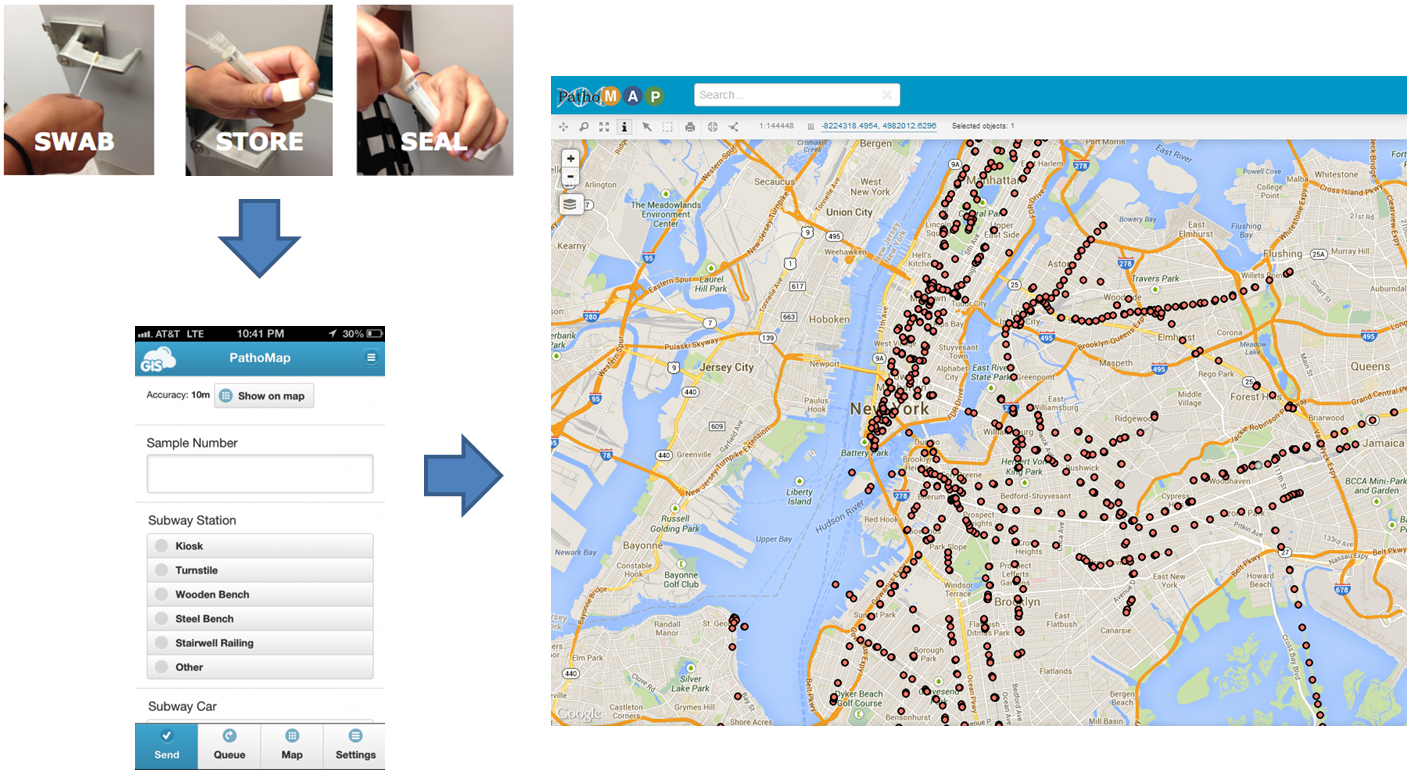 An example from Patho Map project : Displaying the pathogen map or “PathoMap” of New York City and surrounding areas
So, the first, most obvious use of GIS for academic projects in a wider sense is for the uses of collaboration on various projects between different disciplines.
In a more direct and narrower sense, GIS is widely used in educating the generations of geographers and GIS experts. But, we shouldn’t stop at educating only in the area of geographical research and theory. GIS software can also be used in teaching various subjects such as environmental studies, earth science, history, mathematics, chemistry, biology, languages, arts, etc. We can say that GIS technology is present on all levels of education, from elementary schools to higher education, where the most of its academic usage is concentrated, unifying its purpose as a research tool together with instructive quality. For example, it is a very commonly used tool for undergraduate and graduate research projects.
Observing widely, we can see GIS software used in schools, at technical colleges, universities, libraries, museums and other educational institutions.
So, what would be the basic reason for such a wide application of mapping software?
As an instructional tool, GIS serves its purpose as a great way of encouraging students to employ critical thinking, engage in projects and surveys and boost their problem-solving skills. This technology gives the students a good perspective in visualization of spatial patterns, linkages, and relationships. It enhances their numerical and information processing skills and also helps develop the general linguistic intelligence needed for reading and interpreting visible symbols and word information.
Taking into account a strong orientation on visual images present in the contemporary culture, there is no reason why educators wouldn’t encourage the rise of spatial and map literacy.
Namely, the importance of visual preview in education is supported by the fact that humans process images 60, 000 times faster than text.
Also, people remember only around 20% of what they read alone, compared to 80% of what they see.
A history class is a good example in this case. Maps are used to communicate not only spatial, but also historical data. Therefore, interactive maps can be great teaching tools for history classes. They proved to be a good way for remembering a big amount of historical data.Also, people remember only around 20% of what they read alone, compared to 80% of what they see.
Except for the great value of GIS software for instructional purposes, there is one more aspect of its usage in the education.
Mapping*applications, as an essential part of GIS software, can also be used in educational administration and forming education policies.
<div style="float: right; margin: 10px;"><div id="attachment_9665" style="width: 310px" class="wp-caption alignleft"><a href="http://www.giscloud.com/wp-content/uploads/2015/08/unnamed-1.jpg?8f6417">