
Flooding in Dhaka, Bangladesh is not a new problem as it’s located on the extensive floodplains of the Ganges and Brahmaputra Rivers. The flood season occurs during the monsoon rainfall ( May to October). However, the city of Dhaka experiences intensified flooding ( flash flooding) due to extensive built-up areas and inadequate drainage paths; clogged with huge volumes of garbage that blocks the existing drainage system. According to studies done by Danish Hydraulic Institute on Dhaka’s flood problem have found that poor drainage capacity of stormwater are due to poor garbage collection and plastic bags clogging the stormwater. According to their findings the areas of Shantinagar and Motijheel got flooded up to 0.5 to 0.8 meters (1) for days as Segunbagicha Khal ( open stormwater ) that drains into the rivers is not operational due to illegal settlements, and garbage piled up along the stormwater drainage. Major national and international business offices are located in Shantinagar and Motijheel and frequent flooding and standing water cause damages in millions.
Building of drainage systems and maintenance are expensive. Similarly garbage collection system in Dhaka, is poor because of growing population ( 15 million , 2014) and lack of space for landfills. City of Dhaka would be better off in reducing the flooding by using alternative methods such as rainwater harvesting.
A rainwater harvesting system collects water from a roof piped to a storage tank where it is then used either inside or outside a building. Designs range from a simple rain barrel at the bottom of a downspout for watering a garden to extensive cistern systems that can provide a substantial amount of the water someone uses.
Rainwater Harvesting
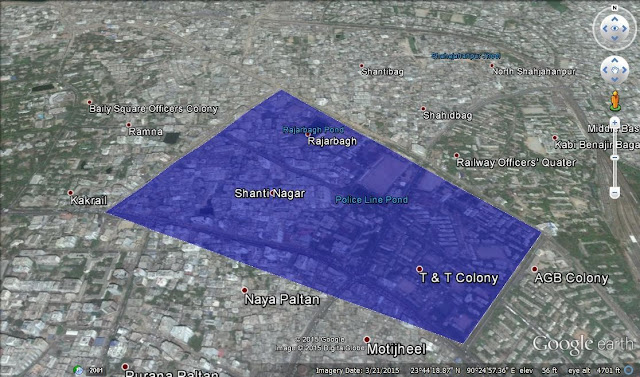
Flood prevention through rainwater harvesting is a smart choice as it’s cost- effective and can capture sufficient amount of water. Rainwater harvesting design consist of Roof (catchment area), gutter roof washer, filter and cistern. Dhaka’s annual average rainfall is approx 73.1 inches and almost 80% occurs during the monsoon season. For this project I selected highly built-up area ( mostly high rises) of Shantinagar and some part of Motijheel in Google Earth and calculated the area. The total study area cames to 221.00 acres or 9,626,760 ft2. As majority of the study area is consist of high-rise buildings. I assumed that surface and rooftops area as same in ft2.
It looks from the image that the streets and space between buildings may take up to 10% of total area that wouldn't be available for rain harvesting. I subtracted 10 % of the surface area ( catchment area) for this study. The reduced catchment area equals to 86,740,840 ft2.
The formula for calculating the rainwater
Catchment area (rooftop) ft2 X Average Yearly Rainfall (inches) X 0.46 ( the capture potential)
86,740,840 * 73.1 *0.46 = 2,917,000,000 Gallons of rainwater
catchment area (sq m) 8,058,224
rain harvest volume (m3) 11,042,046
0.46 or 46 % is the potential water capture as not all the rainwater can be captured due to leaks,evaporation and poor roof design. Rainwater harvesting can capture approx 2.9 million gallons of water that could be use for variety of purposes. Rainwater harvesting is an effective method to control flooding. Harvesting 2.9 million gallons of rainwater could reduce the flood levels up to 1.3 meters ( height) ,which is lot more than flood level measured by the Danish hydrologists ( 0.5- 0.8) meters for the same study area as mentioned above. For this study area rainwater harvesting
will eliminate flooding and provide water for different uses.
Height ( m) = Rainwater volume (m3) / Catchment Area ( sq m)
Height ( m) = 11,042,046 / 8,058,224
1.370 m ( flood level)
Citation: (1) Ole Mark, Terry Kalken, A MOUSE GIS Study Of The Drainage In Dhaka City, Danish Hydraulic Institute, Agern , Denmark.
Nadeem Kazmi .nadeemgis@gmail.com September 14,2015.
أكثر...
Building of drainage systems and maintenance are expensive. Similarly garbage collection system in Dhaka, is poor because of growing population ( 15 million , 2014) and lack of space for landfills. City of Dhaka would be better off in reducing the flooding by using alternative methods such as rainwater harvesting.
A rainwater harvesting system collects water from a roof piped to a storage tank where it is then used either inside or outside a building. Designs range from a simple rain barrel at the bottom of a downspout for watering a garden to extensive cistern systems that can provide a substantial amount of the water someone uses.
Rainwater Harvesting
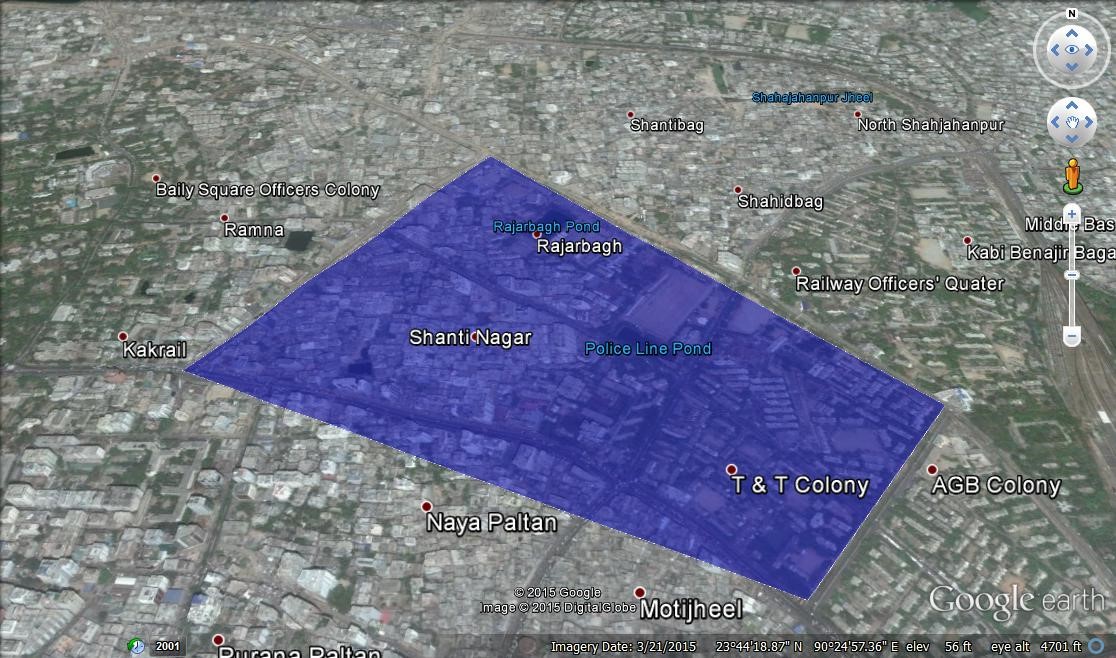
Flood prevention through rainwater harvesting is a smart choice as it’s cost- effective and can capture sufficient amount of water. Rainwater harvesting design consist of Roof (catchment area), gutter roof washer, filter and cistern. Dhaka’s annual average rainfall is approx 73.1 inches and almost 80% occurs during the monsoon season. For this project I selected highly built-up area ( mostly high rises) of Shantinagar and some part of Motijheel in Google Earth and calculated the area. The total study area cames to 221.00 acres or 9,626,760 ft2. As majority of the study area is consist of high-rise buildings. I assumed that surface and rooftops area as same in ft2.
It looks from the image that the streets and space between buildings may take up to 10% of total area that wouldn't be available for rain harvesting. I subtracted 10 % of the surface area ( catchment area) for this study. The reduced catchment area equals to 86,740,840 ft2.
The formula for calculating the rainwater
Catchment area (rooftop) ft2 X Average Yearly Rainfall (inches) X 0.46 ( the capture potential)
86,740,840 * 73.1 *0.46 = 2,917,000,000 Gallons of rainwater
catchment area (sq m) 8,058,224
rain harvest volume (m3) 11,042,046
0.46 or 46 % is the potential water capture as not all the rainwater can be captured due to leaks,evaporation and poor roof design. Rainwater harvesting can capture approx 2.9 million gallons of water that could be use for variety of purposes. Rainwater harvesting is an effective method to control flooding. Harvesting 2.9 million gallons of rainwater could reduce the flood levels up to 1.3 meters ( height) ,which is lot more than flood level measured by the Danish hydrologists ( 0.5- 0.8) meters for the same study area as mentioned above. For this study area rainwater harvesting
will eliminate flooding and provide water for different uses.
Height ( m) = Rainwater volume (m3) / Catchment Area ( sq m)
Height ( m) = 11,042,046 / 8,058,224
1.370 m ( flood level)
Citation: (1) Ole Mark, Terry Kalken, A MOUSE GIS Study Of The Drainage In Dhaka City, Danish Hydraulic Institute, Agern , Denmark.
Nadeem Kazmi .nadeemgis@gmail.com September 14,2015.
أكثر...