
Eye on Earth (Day 2 – Afternoon) – Cost of knowledge, citizen science & visualisation
The first afternoon session was dedicated to Understanding the Costs of Knowledge – Cost of Data Generation and Maintenance*(my second day morning post is here)
 The session was moderated by Thomas Brooks (IUCN) – over the last couple of days we heard about innovation in mobilisation of environmental and socio-economic data. All these innovations have price tag, and some are quite large. Need budget for it and pay for it accordingly. Establishing costs for knowledge products in biodiversity is important. First, four products are explored and then the costs analysed.
 Richard Jenkins – IUCN read list of Threatened Species. He explain the list and the essential procedures and components that created it. The red list is a framework for classifying threatened species with different classifications with vulnerable, engendered or critically engendered are included*in the list. It’s critical source for conservation – over 75,000 species, with over 3,000,000 people visiting the website each year to find information. The foundation of the information is a structured process with ongoing cycles of evaluation and analysis. They are based on donor support – volunteer time in data collections, as well as professional time to evaluate the information and running an on-line database. Costs include workshops, training and travel, for professional time there is communications, researchers, developers, fund raisers and ICT costs: hosting, maintenance, software licensing, hardware etc. The costs can be one-off (setting new system), recurring costs (evaluations) and annual costs (systems and people). Need partnerships, voluntarism – essential and need to be recognised. Re-assessment are needed and also developing tools & uptake
 Jon Paul Rodriguez – IUCN Red List of Ecosystems, as an emerging*product – ecosystem collapse is transformation beyond typical situation. Example for this is Aral Sea – with impact on wildlife and human life around it. They use a risk model for ecosystems with 4 symptoms*as criteria. Similar categories to the species red list. They do global assessment at continental scale and national scale. Costs: compilation of data which are spatial information is complex, time consuming and challenging. There is economy of scale is you do it at regional / global analyses, and first assessment is costly, but updates will be cheaper. The benefits: ecosystem mapping can be used for other knowledge products (e.g. protected areas), capacity-building model, and doing it with open access data. The potential of integration with the two red lists there is a more effective products. Commercial users will need to pay.
Ian May – birdlife international – *key biodiversity areas (KBAs). Set of information about sites that are identified for biodiversity conservation using standard criteria by a range of bodies. There are important bird areas, critical ecosystem partnership fund areas (particular hotspots in multiple taxa). Future direction is to standardise the KBAs. They are used into IFC Performance Standard 6 that force development banks to take them into account, they are integrated in Natura 2000 Birds Directive and in CBD Aichi Targets.
 Naomi Kingston – WCMC – protected area (Protected Planet product) – it’s a project about deliver, connect, analyse and change – world database on protected areas. Have been in development since 1959, evolving from list of national parks and equivalent reserves. There are 700 data providers globally but also NGOs and community groups. Database that evolved over time need to be treated carefully and consider what each polygon and point mean. There is 91.3% polygon data, and grown from 41,305 sites in 1998 to 200,000 today. They raise profile through different activities. There is a website – www.protectedplanet.net . Data is supposed to be updated every 5 years, and is used in SDGs, academic research and strategic plan for biodiversity. They want to see decisions that are based on it – e.g. IBAT*that support business. There is direct connection between resources that are available to the ability to provide training, outreach and capacity building .
 Dieggo Juffe – costing the knowledge products – he assessed the financial investment in developing and maintaining biodiversity information. evaluating development costs to 2013, maintenance and future costs. The datasets that were covered are used in decision making, academic research and more. They developed methodology to evaluate primary data collection costs, network supporting costs, national red lists of species, and the costs of producing scientific papers. They looks on different aspects: personnel, infrastructure, workshop & travel and publication and outreach, looking at all the funding – from donors, private sector, government, NGOs etc., including volunteer time and converted it to USD in 2014. Looked at data since the 1980s to 2013. Today, investment between $116 to $204 USD in development and maintenance. 67,000 to 73,000 volunteer days – almost 200*years. Annual investment 6.5 Mil and 12.5 volunteer days/year . Most was funded from philanthropy (53%) and government 27%. Very large investment in personnel. They exect that future investment to 2020 will be in the range of 100 mil USD. That will give us a comprehensive baseline. Without data we can’t make decision, This is very small compare to census running to other systems. Some of the open questions: what’s the impact of this investment? are there better way to make the products even more cost-effective? what is the real cost of volunteer time? How to avoid duplication of effort?
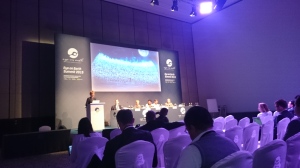 A second afternoon session focused on Everyone is a supplier: Crowd-sourcing and citizen science and indigenous knowledge.*Craig Hanson (WRI) opened with a comment that there is a lot of data from remote sensing, professional scientists –*but*what the role of citizens? there are 7 billion*mobile phone and worldwide and with near global Internet connectivity, citizens anywhere are now capable of being the eyes and ears of the planet. *The*session looked at*successful approaches for engaging people to crowd-source data and contribute to citizen science, and how indigenous knowledge can be systematically integrated into decision-making. With applications from around the world. WRI is *also involved in this process, and in global forest watch – started from partners processing data, but satellite can’t see everything, and JGI and WRI use ODK* to provide ground truth on forest clearing.
Jacquie McGlade covered UNEP Live – citizen science mentioned many time in the summit, but now we need to make voices heard. We need alternative models of how the world operate. All UNEP assessment will include alternative views of mother earth – a challenge for western science point of view. UNEP Live was designed to give citizen access to data that was*collected by governments, but now it also include citizen science – there are now legislations that include rights for people to gather data and making sure that these data are used in decision making. It’s all about co-production of knowledge. From the structured world with metadata and schema to the unstructured data of social media and NGOs. The idea of co-prodcution of knowledge, require management of knowledge with ontologies, and noticing 23 different definition of legal, many definition of access or forest and this is a challenge. SDG interface catalogue is providing the ontology. Example from climate change in the Arctic or in species monitoring in ecosystem capital account that involve forest communities. Motivating people is important – air quality is a great opportunity for citizen science with local interest with information. People in Kibera were willing to pay for access to air quality equipment as they see it as*important for their children.
Brian Sullivan (Google Earth Outreach) – everyone is supplier. Indigenous groups using tools for telling stories, environmental monitoring and the protected area of the Surui is been*included in partnership with Google. They’ve done cultural mapping with the Surui and worked with other communities who decide if they want to make it public or private. Environmental monitoring was another activity – using ODK. They build*resource use and other information that help to protect the land. They are working with other groups in Brazil. Another project is Global Fishing Watch – visualising fishing fleet. Using machine learning, they have been monitoring fishing, and it also allow you to zoom in*to specific ship. Monitoring areas when there are limited resources and they can’t enforce by sending ship.
 Tunitiak Katan looking at his tribal territory in Ecuador – the national context, indigenous people, in climate change and measurement. Ecuador have many indigenous groups – 11 different cultures. He was involved in carbon estimation and ecosystem assessment. Working with different groups using traditional ecological knowledge (ancestors knowledge). The explore the issues of climate discussions with different groups from 9 cultures, with 312 people discussing REDD/REDD+. They carried out measurements in the Amazon demonstrating carbon capture. Now they carry out a project at Kutuk
أكثر...
The first afternoon session was dedicated to Understanding the Costs of Knowledge – Cost of Data Generation and Maintenance*(my second day morning post is here)
 The session was moderated by Thomas Brooks (IUCN) – over the last couple of days we heard about innovation in mobilisation of environmental and socio-economic data. All these innovations have price tag, and some are quite large. Need budget for it and pay for it accordingly. Establishing costs for knowledge products in biodiversity is important. First, four products are explored and then the costs analysed.
 Richard Jenkins – IUCN read list of Threatened Species. He explain the list and the essential procedures and components that created it. The red list is a framework for classifying threatened species with different classifications with vulnerable, engendered or critically engendered are included*in the list. It’s critical source for conservation – over 75,000 species, with over 3,000,000 people visiting the website each year to find information. The foundation of the information is a structured process with ongoing cycles of evaluation and analysis. They are based on donor support – volunteer time in data collections, as well as professional time to evaluate the information and running an on-line database. Costs include workshops, training and travel, for professional time there is communications, researchers, developers, fund raisers and ICT costs: hosting, maintenance, software licensing, hardware etc. The costs can be one-off (setting new system), recurring costs (evaluations) and annual costs (systems and people). Need partnerships, voluntarism – essential and need to be recognised. Re-assessment are needed and also developing tools & uptake
 Jon Paul Rodriguez – IUCN Red List of Ecosystems, as an emerging*product – ecosystem collapse is transformation beyond typical situation. Example for this is Aral Sea – with impact on wildlife and human life around it. They use a risk model for ecosystems with 4 symptoms*as criteria. Similar categories to the species red list. They do global assessment at continental scale and national scale. Costs: compilation of data which are spatial information is complex, time consuming and challenging. There is economy of scale is you do it at regional / global analyses, and first assessment is costly, but updates will be cheaper. The benefits: ecosystem mapping can be used for other knowledge products (e.g. protected areas), capacity-building model, and doing it with open access data. The potential of integration with the two red lists there is a more effective products. Commercial users will need to pay.
Ian May – birdlife international – *key biodiversity areas (KBAs). Set of information about sites that are identified for biodiversity conservation using standard criteria by a range of bodies. There are important bird areas, critical ecosystem partnership fund areas (particular hotspots in multiple taxa). Future direction is to standardise the KBAs. They are used into IFC Performance Standard 6 that force development banks to take them into account, they are integrated in Natura 2000 Birds Directive and in CBD Aichi Targets.
 Naomi Kingston – WCMC – protected area (Protected Planet product) – it’s a project about deliver, connect, analyse and change – world database on protected areas. Have been in development since 1959, evolving from list of national parks and equivalent reserves. There are 700 data providers globally but also NGOs and community groups. Database that evolved over time need to be treated carefully and consider what each polygon and point mean. There is 91.3% polygon data, and grown from 41,305 sites in 1998 to 200,000 today. They raise profile through different activities. There is a website – www.protectedplanet.net . Data is supposed to be updated every 5 years, and is used in SDGs, academic research and strategic plan for biodiversity. They want to see decisions that are based on it – e.g. IBAT*that support business. There is direct connection between resources that are available to the ability to provide training, outreach and capacity building .
 Dieggo Juffe – costing the knowledge products – he assessed the financial investment in developing and maintaining biodiversity information. evaluating development costs to 2013, maintenance and future costs. The datasets that were covered are used in decision making, academic research and more. They developed methodology to evaluate primary data collection costs, network supporting costs, national red lists of species, and the costs of producing scientific papers. They looks on different aspects: personnel, infrastructure, workshop & travel and publication and outreach, looking at all the funding – from donors, private sector, government, NGOs etc., including volunteer time and converted it to USD in 2014. Looked at data since the 1980s to 2013. Today, investment between $116 to $204 USD in development and maintenance. 67,000 to 73,000 volunteer days – almost 200*years. Annual investment 6.5 Mil and 12.5 volunteer days/year . Most was funded from philanthropy (53%) and government 27%. Very large investment in personnel. They exect that future investment to 2020 will be in the range of 100 mil USD. That will give us a comprehensive baseline. Without data we can’t make decision, This is very small compare to census running to other systems. Some of the open questions: what’s the impact of this investment? are there better way to make the products even more cost-effective? what is the real cost of volunteer time? How to avoid duplication of effort?
 A second afternoon session focused on Everyone is a supplier: Crowd-sourcing and citizen science and indigenous knowledge.*Craig Hanson (WRI) opened with a comment that there is a lot of data from remote sensing, professional scientists –*but*what the role of citizens? there are 7 billion*mobile phone and worldwide and with near global Internet connectivity, citizens anywhere are now capable of being the eyes and ears of the planet. *The*session looked at*successful approaches for engaging people to crowd-source data and contribute to citizen science, and how indigenous knowledge can be systematically integrated into decision-making. With applications from around the world. WRI is *also involved in this process, and in global forest watch – started from partners processing data, but satellite can’t see everything, and JGI and WRI use ODK* to provide ground truth on forest clearing.
Jacquie McGlade covered UNEP Live – citizen science mentioned many time in the summit, but now we need to make voices heard. We need alternative models of how the world operate. All UNEP assessment will include alternative views of mother earth – a challenge for western science point of view. UNEP Live was designed to give citizen access to data that was*collected by governments, but now it also include citizen science – there are now legislations that include rights for people to gather data and making sure that these data are used in decision making. It’s all about co-production of knowledge. From the structured world with metadata and schema to the unstructured data of social media and NGOs. The idea of co-prodcution of knowledge, require management of knowledge with ontologies, and noticing 23 different definition of legal, many definition of access or forest and this is a challenge. SDG interface catalogue is providing the ontology. Example from climate change in the Arctic or in species monitoring in ecosystem capital account that involve forest communities. Motivating people is important – air quality is a great opportunity for citizen science with local interest with information. People in Kibera were willing to pay for access to air quality equipment as they see it as*important for their children.
Brian Sullivan (Google Earth Outreach) – everyone is supplier. Indigenous groups using tools for telling stories, environmental monitoring and the protected area of the Surui is been*included in partnership with Google. They’ve done cultural mapping with the Surui and worked with other communities who decide if they want to make it public or private. Environmental monitoring was another activity – using ODK. They build*resource use and other information that help to protect the land. They are working with other groups in Brazil. Another project is Global Fishing Watch – visualising fishing fleet. Using machine learning, they have been monitoring fishing, and it also allow you to zoom in*to specific ship. Monitoring areas when there are limited resources and they can’t enforce by sending ship.
 Tunitiak Katan looking at his tribal territory in Ecuador – the national context, indigenous people, in climate change and measurement. Ecuador have many indigenous groups – 11 different cultures. He was involved in carbon estimation and ecosystem assessment. Working with different groups using traditional ecological knowledge (ancestors knowledge). The explore the issues of climate discussions with different groups from 9 cultures, with 312 people discussing REDD/REDD+. They carried out measurements in the Amazon demonstrating carbon capture. Now they carry out a project at Kutuk
أكثر...