
INT. APARTMENT IN CAMBRIDGE MASS
Andy is being yelled at by someone less familiar with the region for never mentioning (apparently in an act of deliberate deception) that the area across the river from his home is part of Boston. You see, he always refers to it by its neighborhood name, Allston, which made it sound like a separate town.
The scene above got me thinking about the geography of place name hierarchies. I speak of locations in Boston almost exclusively according to particular neighborhood names because from my perspective “Boston” is too broad and unhelpful. It might mean a thousand feet away over a bridge, or it might mean something ten miles away; it might mean somewhere west of here or it might mean somewhere east. But to someone farther away, neighborhood-level specificity seems less necessary when speaking about the place.
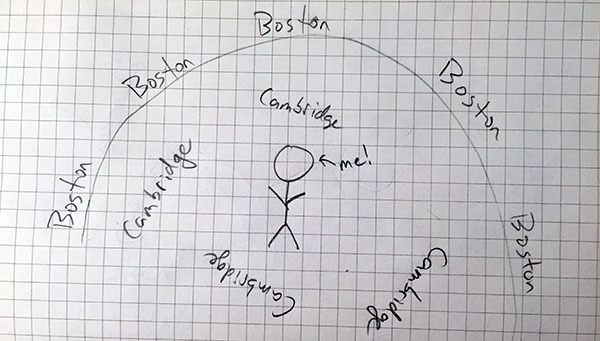
At what distance away does casual reference break down from whole-city to individual neighborhoods? The question feeds into some of my thinking about about what a “city” is irrespective of municipal boundaries: if there’s a point outside the official city where most of the time it makes sense to speak of the city in terms of its sub-units, it may be reasonable to think of that point as part of the city, unofficially. What would a map of those points looks like? In a related and perhaps a more familiar scenario, how far away before a town near City X is absorbed into the “City X” name in casual conversation?
I hopped on Twitter to think aloud and got into some interesting conversations with the late night and/or west coast crowd. (Follow the threads here if you care.) A common theme was the notion that this is not strictly a geographical question, and it certainly does have to do with knowledge and identities and all that. (I take issue with anyone who ignores that those are related to geography, though.) In any case, it remains an intriguing and perhaps answerable question, but just for a lark I wanted to pursue one potential spatial measure that Mike Migurski tossed out:
أكثر...
Andy is being yelled at by someone less familiar with the region for never mentioning (apparently in an act of deliberate deception) that the area across the river from his home is part of Boston. You see, he always refers to it by its neighborhood name, Allston, which made it sound like a separate town.
The scene above got me thinking about the geography of place name hierarchies. I speak of locations in Boston almost exclusively according to particular neighborhood names because from my perspective “Boston” is too broad and unhelpful. It might mean a thousand feet away over a bridge, or it might mean something ten miles away; it might mean somewhere west of here or it might mean somewhere east. But to someone farther away, neighborhood-level specificity seems less necessary when speaking about the place.
At what distance away does casual reference break down from whole-city to individual neighborhoods? The question feeds into some of my thinking about about what a “city” is irrespective of municipal boundaries: if there’s a point outside the official city where most of the time it makes sense to speak of the city in terms of its sub-units, it may be reasonable to think of that point as part of the city, unofficially. What would a map of those points looks like? In a related and perhaps a more familiar scenario, how far away before a town near City X is absorbed into the “City X” name in casual conversation?
I hopped on Twitter to think aloud and got into some interesting conversations with the late night and/or west coast crowd. (Follow the threads here if you care.) A common theme was the notion that this is not strictly a geographical question, and it certainly does have to do with knowledge and identities and all that. (I take issue with anyone who ignores that those are related to geography, though.) In any case, it remains an intriguing and perhaps answerable question, but just for a lark I wanted to pursue one potential spatial measure that Mike Migurski tossed out:
I think bearing has something to do with it: distance + scale, and are all the parts in the same direction? Then it’s the whole.
Maybe subtended angle?
Subtended angle in this case means, more or less, how much of your 360Maybe subtended angle?
أكثر...